Finding the right lawyer in Italy often leaves international clients feeling uncertain about where to start. Moreover, navigating Italy’s legal landscape without proper guidance can lead to costly mistakes and unnecessary delays. Therefore, understanding how to choose a lawyer in Italy becomes essential for anyone facing legal matters in the country. Furthermore, whether you’re dealing with real estate transactions, business formation, immigration issues, or criminal defense, selecting qualified legal representation significantly impacts your case outcome. Additionally, for expatriates and foreign businesses operating in Italy, language barriers and unfamiliar legal procedures compound these challenges. Consequently, a clear, systematic approach to hiring a lawyer in Italy can save you time, reduce stress, and ensure you receive expert representation aligned with your specific needs.
Table of Contents
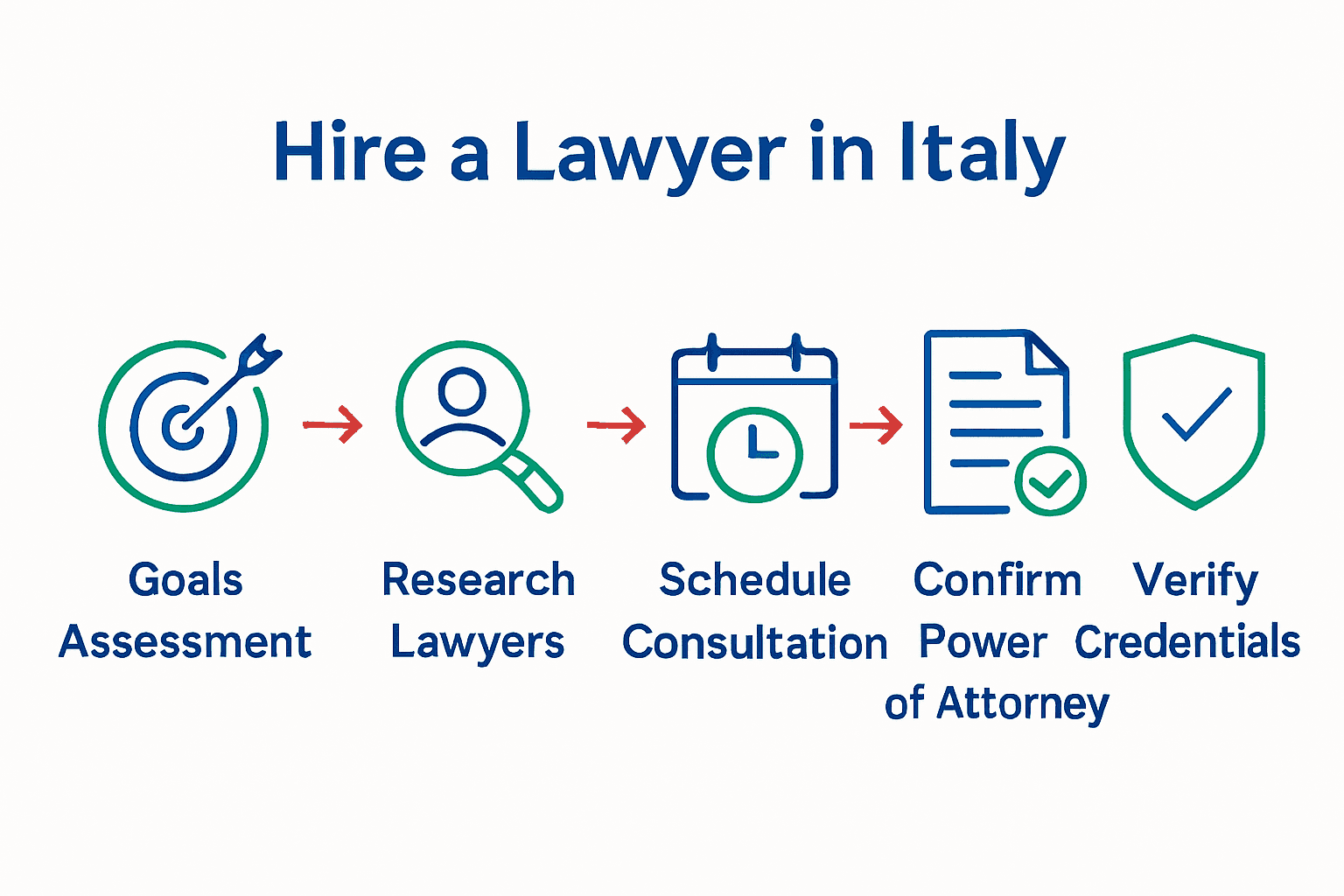
- Step 1: Define Your Legal Needs and Goals
- Step 2: Research and Evaluate Qualified Lawyers
- Step 3: Contact Lawyers and Request Consultations
- Step 4: Verify Credentials and Specializations
- Step 5: Agree on Terms of Engagement
- Working with English-Speaking Lawyers in Italy
Quick Summary
| Step | Key Actions | Why It Matters |
|---|---|---|
| 1. Define Legal Needs | Assess your specific legal issue, desired outcomes, and case complexity | Identifies the right type of lawyer and specialization needed |
| 2. Research Lawyers | Find qualified lawyers with relevant expertise and international client experience | Ensures you work with professionals who understand your situation |
| 3. Schedule Consultations | Meet multiple lawyers to compare approaches and communication styles | Helps you evaluate compatibility and expertise before committing |
| 4. Verify Credentials | Confirm bar registration, specializations, and professional qualifications | Protects you from unqualified practitioners and ensures competence |
| 5. Agree on Terms | Establish clear written agreement covering fees, scope, and communication | Prevents misunderstandings and protects both parties’ interests |
Step 1: Define Your Legal Needs and Goals
Understanding Your Legal Situation
Defining your legal needs and goals is the critical first step in successfully hiring a lawyer in Italy. Moreover, this process involves carefully assessing your specific legal situation and understanding the type of professional assistance you require. Furthermore, clarity about your legal needs enables you to identify the right lawyer more efficiently and communicate your situation effectively during consultations.
Begin by conducting a thorough self-assessment of your legal challenge. Additionally, ask yourself fundamental questions about your situation: Are you dealing with a civil matter like property disputes or contract issues? A criminal defense matter? An immigration concern? Business formation or compliance? Family law issues? Therefore, understanding the precise nature of your legal needs will help you identify the right type of legal professional with appropriate specialization.
Breaking Down Your Legal Issue
Consider organizing your situation into specific elements to gain better clarity:
- Nature of Legal Issue – Identify whether it’s civil, criminal, administrative, commercial, or family law
- Desired Outcomes – Define what success looks like for your case (settlement, court victory, legal compliance, etc.)
- Case Complexity – Assess whether your matter is straightforward or involves multiple legal areas
- Timeline Requirements – Determine any urgent deadlines or time-sensitive elements
- International Dimensions – Identify any cross-border aspects requiring specialized knowledge
- Language Needs – Consider whether you need an English-speaking lawyer for effective communication
Understanding Italian Legal Categories
Once you have a clear picture of your legal needs, research which category of Italian lawyers specializes in your specific area. Moreover, Italian lawyers often focus on particular practice areas, and matching your needs with appropriate specialization significantly impacts your case outcome. Furthermore, when searching, prioritize professionals who have experience working with international clients and understand the nuances of cross-border legal challenges.
Common legal specializations in Italy include:
- Real Estate Law (Diritto Immobiliare) – Property purchases, leases, disputes
- Corporate and Business Law (Diritto Societario) – Company formation, contracts, compliance
- Immigration Law (Diritto dell’Immigrazione) – Visas, residency, citizenship
- Criminal Law (Diritto Penale) – Criminal defense and prosecution
- Family Law (Diritto di Famiglia) – Divorce, custody, inheritance
- Labor Law (Diritto del Lavoro) – Employment contracts, workplace disputes
- Tax Law (Diritto Tributario) – Tax compliance, disputes with revenue authorities
- Intellectual Property (Proprietà Intellettuale) – Patents, trademarks, copyrights
Financial Considerations
As you refine your goals, be prepared to discuss financial considerations openly. Moreover, understanding potential legal costs upfront helps you make informed decisions and budget appropriately. Additionally, Italian lawyers typically charge either hourly rates, flat fees for specific services, or contingency arrangements depending on the case type. Therefore, having realistic expectations about legal costs prevents financial surprises later.
Step 2: Research and Evaluate Qualified Lawyers
Strategic Research Approach
Researching and evaluating qualified lawyers in Italy requires strategic investigation and careful assessment. Moreover, your goal is to find a legal professional who not only understands your specific legal challenge but can effectively navigate the complexities of the Italian legal system. Furthermore, thorough research at this stage prevents costly mistakes and ensures you work with competent, qualified professionals.
Essential Qualification Criteria
Start by leveraging multiple resources to compile a list of potential lawyers. Additionally, understanding legal qualifications is crucial when evaluating potential legal representation. Therefore, look for lawyers who meet these essential criteria:
- Bar Registration – Confirmed registration with the Italian Bar Association (Ordine degli Avvocati)
- Relevant Specialization – Specific expertise in your legal area with proven track record
- International Client Experience – Demonstrated experience working with foreign clients and cross-border matters
- Language Proficiency – Fluent English communication abilities for clear understanding
- Professional Reputation – Positive reviews, testimonials, and professional standing
- Accessibility – Responsive communication and willingness to explain complex legal concepts
Research Resources and Methods
Use multiple channels to identify and research potential lawyers:
- Bar Association Directories – Search the online registers of local Ordini degli Avvocati to verify registration and specializations
- Professional Websites – Review lawyers’ websites for information about their practice areas, experience, and approach
- Online Reviews – Check Google reviews, testimonials, and professional ratings (while considering their limitations)
- Embassy Recommendations – Many embassies maintain lists of English-speaking lawyers for their citizens
- Professional Networks – Ask for referrals from business associations, expat communities, or professional contacts
- Legal Directories – Consult international legal directories that list Italian lawyers by specialization
Evaluating English-Speaking Capabilities
For international clients, prioritizing lawyers who specialize in English-speaking legal services ensures clear communication and comprehensive understanding of your legal needs. Moreover, effective communication in your native language prevents misunderstandings that could negatively impact your case. Furthermore, English-speaking lawyers experienced with international clients better understand the cultural and legal differences you face.
When reviewing potential candidates, examine multiple aspects of their professional profile:
- Professional Credentials – Education, bar admission date, professional certifications
- Practice Focus – Percentage of practice devoted to your type of legal matter
- Case History – Track record with similar cases and outcomes achieved
- Publications and Speaking – Legal articles, conference presentations, or teaching activities
- Professional Associations – Membership in specialized legal associations or international networks
Creating Your Shortlist
A strategic approach involves creating a shortlist of 3-5 lawyers for initial consultations. Moreover, this allows you to compare their expertise, communication style, and proposed strategies before making a final decision. Additionally, meeting multiple lawyers provides valuable perspective on different approaches to your legal issue and helps you identify the best fit for your needs.
Step 3: Contact Lawyers and Request Consultations
Preparing Your Initial Contact
Contacting potential lawyers and scheduling initial consultations is a critical step in finding the right legal representation for your needs in Italy. Moreover, this process requires strategic communication and careful preparation to maximize the value of your interactions. Furthermore, the way you present your case during initial contact often influences the lawyer’s assessment and their willingness to take your case.
Crafting Your Communication
Begin by preparing a comprehensive but concise summary of your legal situation. Additionally, when reaching out to lawyers, consider these effective communication strategies:
- Professional Introduction – Briefly introduce yourself and explain how you found the lawyer
- Clear Case Summary – Provide a concise overview of your legal issue (2-3 paragraphs maximum)
- Specific Questions – Ask about their experience with similar cases and approach to your type of matter
- Timeline Information – Mention any urgent deadlines or time-sensitive aspects
- Consultation Request – Explicitly request an initial consultation and ask about fees
- Availability – Provide your availability and preferred contact method
Consultation Formats
When scheduling your legal consultation in Italy, understand the various formats available. Moreover, many lawyers offer initial consultations through different channels to accommodate international clients:
- In-Person Meetings – Traditional office consultations allowing face-to-face interaction
- Video Conferences – Remote consultations via Zoom, Skype, or other platforms
- Phone Consultations – Initial discussions by telephone
- Email Exchanges – Written correspondence for preliminary case assessment
For international clients, video conferencing has become increasingly common and effective. Furthermore, this format allows you to have substantive discussions without traveling to Italy, saving time and money while still enabling visual communication.
Consultation Preparation Checklist
A critical tip is to come thoroughly prepared to maximize the value of your consultation time:
- Document Organization – Gather all relevant documents, contracts, correspondence, and evidence
- Timeline Creation – Prepare a chronological timeline of events related to your case
- Question List – Write down all questions you want answered during the consultation
- Budget Information – Be ready to discuss your budget and fee expectations
- Goals Clarification – Clearly articulate what you hope to achieve
- Background Materials – Prepare any background information that provides context
What to Observe During Consultations
During the consultation, pay close attention to multiple factors beyond just legal advice:
- Communication Style – Does the lawyer explain concepts clearly in language you understand?
- Active Listening – Does the lawyer listen carefully to your concerns and ask clarifying questions?
- Legal Knowledge – Does the lawyer demonstrate expertise in relevant areas of law?
- Strategic Thinking – Does the lawyer propose concrete strategies or just generalities?
- Honesty – Does the lawyer provide realistic assessments or make unrealistic promises?
- Responsiveness – How quickly did the lawyer respond to your initial contact?
- Professional Demeanor – Does the lawyer conduct themselves professionally and respectfully?
Key Questions to Ask
Come prepared with specific questions to ask during consultations:
- How many cases similar to mine have you handled, and what were the outcomes?
- What is your assessment of my case’s strengths and potential challenges?
- What strategy would you recommend for my situation?
- What is your fee structure, and what total costs should I anticipate?
- How long do you estimate my case will take to resolve?
- Who will actually work on my case (you personally or associates)?
- How often will you communicate updates, and through what channels?
- What information or documents do you need from me to proceed?
- Are there any conflicts of interest or reasons you might not be able to represent me?
- Can you provide references from previous international clients?

Step 4: Verify Credentials and Specializations
Importance of Credential Verification
Verifying your lawyer’s credentials and specializations is a critical step in ensuring you work with a qualified, competent professional. Moreover, this verification process protects you from unqualified practitioners and provides confidence in your legal representation. Furthermore, in Italy’s regulated legal profession, specific credentials indicate training, expertise, and professional standing that directly impact case outcomes.
Essential Credential Checks
When examining a lawyer’s credentials, focus on these key verification points:
- Bar Association Registration – Confirm current registration with the appropriate Ordine degli Avvocati
- Registration Number – Verify the lawyer’s unique bar registration number (numero di iscrizione all’albo)
- Registration Date – Check when the lawyer was first admitted to practice
- Disciplinary History – Verify absence of serious disciplinary actions or sanctions
- Professional Insurance – Confirm the lawyer maintains required professional indemnity insurance
- Good Standing – Ensure the lawyer’s registration is active and in good standing
How to Verify Italian Bar Registration
You can verify a lawyer’s registration through several methods:
- Online Bar Registers – Most local bar associations maintain searchable online databases
- Direct Contact – Contact the relevant Ordine degli Avvocati by phone or email
- National Council – Check with the Consiglio Nazionale Forense (National Council of Lawyers)
- Request Documentation – Ask the lawyer directly to provide proof of current registration
Understanding the register of lawyers Italy system helps you navigate the verification process effectively and understand what different registrations mean.
Verifying Specializations
Beyond basic bar registration, verify any claimed specializations:
- Official Specialization Certificates – Italy recognizes formal specializations that require additional training and examination
- Advanced Degrees – Master’s degrees (LLM) or specialized legal training in relevant areas
- Professional Certifications – International certifications or specialized training programs
- Teaching Positions – University teaching appointments or academic publications
- Professional Association Memberships – Membership in specialized legal associations
Educational Background Verification
Review and verify the lawyer’s educational credentials:
- Law Degree – Confirm Laurea Magistrale in Giurisprudenza from accredited Italian university
- Bar Exam – Successful completion of the Italian state bar examination
- Additional Degrees – Any specialized legal degrees or postgraduate qualifications
- International Training – Foreign law degrees or training that enhance cross-border expertise
- Continuing Education – Evidence of ongoing professional development and CLE compliance
Experience and Track Record
Beyond formal credentials, assess the lawyer’s practical experience:
- Years in Practice – Length of time practicing law independently
- Relevant Case Experience – Number and outcomes of cases similar to yours
- Court Experience – Litigation experience in relevant courts if your case involves litigation
- International Clients – Demonstrated experience serving foreign clients successfully
- Language Skills – Verified English proficiency through conversation and written communication
- Client Testimonials – References and reviews from previous clients
Professional Reputation Research
Investigate the lawyer’s professional reputation through multiple channels:
- Peer Recognition – Reputation among other lawyers and legal professionals
- Court Standing – Relationship and reputation with judges and court personnel
- Professional Publications – Legal articles, books, or commentary demonstrating expertise
- Media Presence – Media interviews or expert commentary on legal issues
- Awards and Recognition – Professional awards or recognition from legal organizations
- Embassy Recognition – Inclusion on embassy-recommended lawyer lists
Step 5: Agree on Terms of Engagement
Establishing Clear Terms
Agreeing on clear terms of engagement is the final critical step before formally retaining a lawyer in Italy. Moreover, establishing these terms in writing protects both your interests and the lawyer’s, creating a transparent professional relationship built on mutual understanding. Furthermore, clear terms prevent misunderstandings about fees, scope of work, and expectations that could damage the lawyer-client relationship later.
Essential Elements of Engagement Agreement
Request a detailed written contract (contratto di prestazione professionale) that clearly outlines all key terms:
- Scope of Representation – Precisely defined legal services the lawyer will provide
- Fee Structure – Clear explanation of how fees are calculated and billed
- Cost Estimates – Realistic estimates of total costs and potential additional expenses
- Billing Procedures – How and when invoices will be issued
- Payment Terms – Payment schedules, accepted methods, and currency
- Communication Protocols – How often updates will be provided and through what channels
- Timeline Expectations – Estimated duration for different phases of your case
- Termination Provisions – Conditions under which either party can end the relationship
Understanding Italian Legal Fee Structures
Italian lawyers typically use several fee structures, and understanding these helps you negotiate fair terms:
- Hourly Rates (Tariffa oraria) – Fees based on time spent on your case, typically €150-500+ per hour depending on seniority and specialization
- Flat Fees (Onorario fisso) – Fixed price for specific services like contract review or company formation
- Contingency Fees (Patto di quota lite) – Percentage of recovery in successful cases (limited to certain case types)
- Retainer Arrangements – Advance payment that may be applied to future fees or held as deposit
- Success Bonuses – Additional fees for achieving specific favorable outcomes
- Mixed Models – Combinations of the above approaches
Additional Costs to Clarify
Beyond lawyer fees, clarify all potential additional costs:
- Court Filing Fees (Contributo unificato) – Government fees for filing court documents
- Expert Witness Fees – Costs for technical experts, appraisers, or consultants
- Translation Costs – Official translations of documents when required
- Travel Expenses – If lawyer must travel for your case
- Administrative Costs – Photocopies, courier services, document preparation
- Out-of-Pocket Expenses – Any other costs incurred specifically for your case
Communication and Reporting Terms
Establish clear expectations about communication:
- Response Time – Expected timeframe for lawyer to respond to your inquiries
- Update Frequency – How often you’ll receive case status updates
- Communication Channels – Preferred methods (email, phone, video calls)
- Point of Contact – Whether you work directly with the lawyer or also with associates
- Availability – Lawyer’s typical availability and response to urgent matters
- Language – Confirmation that communications will be in English
Scope of Work Definition
Precisely define what the lawyer will and will not do:
- Included Services – Specific legal services covered by the engagement
- Excluded Services – Services explicitly not covered that would require additional fees
- Deliverables – Specific work products you will receive (contracts, legal opinions, court filings)
- Representation Limits – Courts or proceedings where lawyer will represent you
- Duration – Whether engagement covers entire case or specific phases
Power of Attorney Considerations
If your case requires granting power of attorney (procura):
- Scope of Authority – Exactly what powers you’re granting the lawyer
- Limitations – Any restrictions on the lawyer’s authority to act on your behalf
- Documentation Requirements – How the power of attorney will be executed and authenticated
- Remote Options – Whether you can grant power of attorney remotely or must appear in person
- Revocation Terms – How you can revoke the power of attorney if needed
For detailed information about this process, review our comprehensive guide to power of attorney in Italy.
Confidentiality and Professional Responsibility
Confirm the lawyer’s obligations regarding confidentiality and professional conduct:
- Attorney-Client Privilege – Confirmation of confidentiality protections under Italian law
- Conflicts of Interest – Assurance that no conflicts exist or disclosure if they do
- Professional Insurance – Verification of adequate professional indemnity coverage
- Ethical Obligations – Commitment to follow Italian bar association ethical rules
- Document Security – How client documents and information will be protected
Dispute Resolution Provisions
Include terms addressing potential disputes about the engagement itself:
- Fee Disputes – Process for resolving disagreements about billing
- Mediation – Agreement to attempt mediation before litigation
- Applicable Law – Which jurisdiction’s law governs the engagement agreement
- Venue – Where any disputes about the engagement would be resolved
Working with English-Speaking Lawyers in Italy
The Importance of Language in Legal Representation
Working with an English-speaking lawyer in Italy provides significant advantages for international clients navigating the Italian legal system. Moreover, effective communication in your native language ensures you fully understand your legal situation, options, and the advice you receive. Furthermore, language barriers in legal matters can lead to misunderstandings with serious consequences, making English-language legal services essential for many foreign clients.
Benefits of English-Speaking Legal Representation
Choosing an English-speaking Italian lawyer offers multiple advantages:
- Clear Communication – Complete understanding of complex legal concepts without translation difficulties
- Cultural Understanding – Lawyers serving international clients better understand foreign perspectives and expectations
- Document Clarity – Ability to review and understand legal documents in English
- Informed Decisions – Making fully informed decisions based on complete understanding
- Reduced Errors – Minimizing misunderstandings that could negatively impact your case
- Comfort Level – Greater confidence and comfort discussing sensitive legal matters in your native language
- Cross-Border Expertise – Often possess knowledge of both Italian and foreign legal systems
What to Expect from English-Speaking Services
When working with English-speaking Italian lawyers, you should expect:
- Bilingual Communication – All verbal and written communication available in English
- Document Translation – Translation or explanation of Italian legal documents
- Cultural Mediation – Help understanding Italian legal culture and procedures from a foreign perspective
- International Network – Often connections to legal professionals in other countries when needed
- Expat Experience – Understanding of common issues faced by expatriates in Italy
For more information about these services, explore why you should choose an English-speaking Italian lawyer.
Verifying English Language Proficiency
Not all lawyers who claim English proficiency have the same skill level. Therefore, verify language capabilities:
- Initial Communication – Assess written English in email exchanges
- Phone Conversation – Evaluate spoken English during preliminary calls
- Technical Vocabulary – Confirm ability to explain legal concepts in English
- International Certifications – English language certifications or foreign legal qualifications
- Client References – Speak with other English-speaking clients about communication quality
Balancing English Service with Italian Law Practice
Remember that while communication may be in English, the lawyer practices Italian law:
- Legal System Differences – Italian civil law differs fundamentally from common law systems
- Official Documents – Official court filings and documents will be in Italian
- Court Proceedings – Court proceedings occur in Italian
- Legal Concepts – Some Italian legal concepts don’t have direct English equivalents
- Translation Costs – Official translations may be needed for certain documents
Understanding the differences between Italian civil law and common law systems helps you work more effectively with your Italian lawyer even when communicating in English.
Expert English-Speaking Legal Assistance in Italy
Finding the right lawyer in Italy shouldn’t be complicated or stressful. At Avv. Alfredo Esposito’s international law firm, we specialize in providing comprehensive English-language legal services to expatriates, foreign businesses, and international clients throughout Italy. With extensive experience serving clients from diverse countries and recognition from multiple embassy authorities, we understand both the legal and cultural challenges you face.
Our services cover all aspects of Italian law, including real estate transactions, business formation and compliance, immigration matters, criminal defense, family law, and civil litigation. We provide clear communication, transparent pricing, and personalized attention to every client’s unique situation.
Making the Right Choice for Your Legal Needs in Italy
Choosing the right lawyer in Italy represents one of the most important decisions you’ll make when dealing with legal matters in the country. Moreover, following a systematic approach—defining your needs, researching qualified lawyers, conducting thorough consultations, verifying credentials, and establishing clear terms—significantly increases your chances of finding excellent legal representation. Furthermore, taking time to make an informed decision prevents costly mistakes and ensures you work with a professional who truly understands your situation and can effectively advocate for your interests.
Key Principles for Success
Throughout the lawyer selection process, keep these principles in mind:
- Don’t Rush – Take adequate time to research, compare, and evaluate multiple lawyers
- Prioritize Communication – Choose a lawyer you can communicate with clearly and comfortably
- Verify Everything – Confirm credentials, experience, and qualifications independently
- Get It in Writing – Insist on clear written agreements covering all terms of engagement
- Trust Your Instincts – If something feels wrong, continue your search
- Consider the Relationship – Choose someone you can work with effectively over time
Remember that the right lawyer for your situation combines technical legal expertise with strong communication skills, relevant experience with cases like yours, and a commitment to your success. Additionally, for international clients, working with English-speaking lawyers who understand cross-border issues provides significant advantages in navigating Italy’s legal system effectively.
By following the steps outlined in this guide and taking a thoughtful, deliberate approach to lawyer selection, you position yourself for the best possible legal outcome. Moreover, investing time in finding the right representation pays dividends throughout your legal matter and often determines the difference between success and frustration. Therefore, approach this process seriously, ask tough questions, verify credentials thoroughly, and don’t settle until you find a lawyer who meets all your requirements and inspires confidence in their ability to represent your interests effectively in Italy’s legal system.
Frequently Asked Questions
Recommended Reading
- Why Choose an English-Speaking Italian Lawyer?
- Register of Lawyers Italy: Understanding the Albo degli Avvocati System
- How to Become a Licensed Lawyer in Italy
- 5 Most Common Reasons to Hire a Lawyer in Italy
- Complete Guide to Power of Attorney in Italy
- Italian Civil Law vs American Common Law: Key Differences
- Expats in Italy – Complete Legal Guide and Resources
- Latest Legal Tips for International Clients in Italy