Most newcomers to Italy are surprised to learn that residency and citizenship are not the same and each brings its own set of rights and responsibilities. This distinction matters because it can shape everything from your ability to work to your freedom of movement across Europe. Only full Italian citizens can use their identity card as a travel document across the entire European Economic Area. Understanding these key differences is the first step to making decisions that fit your future in Italy.
Table of Contents
- Defining Italian Residency And Citizenship Status
- Residency In Italy: Types, Process, And Limits
- Understanding Italian Citizenship: Eligibility And Routes
- Key Rights And Legal Differences Explained
- Practical Implications For Foreigners In Italy
Key Takeaways
| Point | Details |
|---|---|
| Residency vs. Citizenship | Understanding the distinction between residency (temporary permission to live) and citizenship (permanent legal membership) is key for expats and professionals in Italy. |
| Residency Permits | Various types of residency permits exist, such as temporary and long-term, each with distinct requirements and rights. |
| Citizenship Pathways | Multiple options for acquiring Italian citizenship include descent, marriage, and naturalization, each with specific criteria. |
| Rights and Obligations | Citizens enjoy greater rights, including full political participation and unrestricted work across the EU, compared to residents with limited privileges. |
Defining Italian Residency and Citizenship Status
Navigating the intricate landscape of Italian legal status requires understanding two fundamental concepts: residency and citizenship. While often used interchangeably, these terms carry distinct legal implications that can significantly impact your rights, obligations, and daily life in Italy.
According to Wikipedia, Italian nationality law outlines specific criteria for acquiring legal status, which includes multiple pathways such as birthright, descent, marriage, and naturalization. Residency represents your official permission to live in Italy, while citizenship denotes a more comprehensive legal membership in the Italian state with expanded rights.
The core differences between residency and citizenship revolve around fundamental legal entitlements. As Wikipedia highlights, Italian citizens enjoy unique privileges – such as using their identity card as a travel document throughout the European Economic Area and Switzerland – that are not automatically extended to legal residents. This distinction underscores the importance of understanding each status’s nuanced legal framework.
Key distinctions between residency and citizenship include:
-
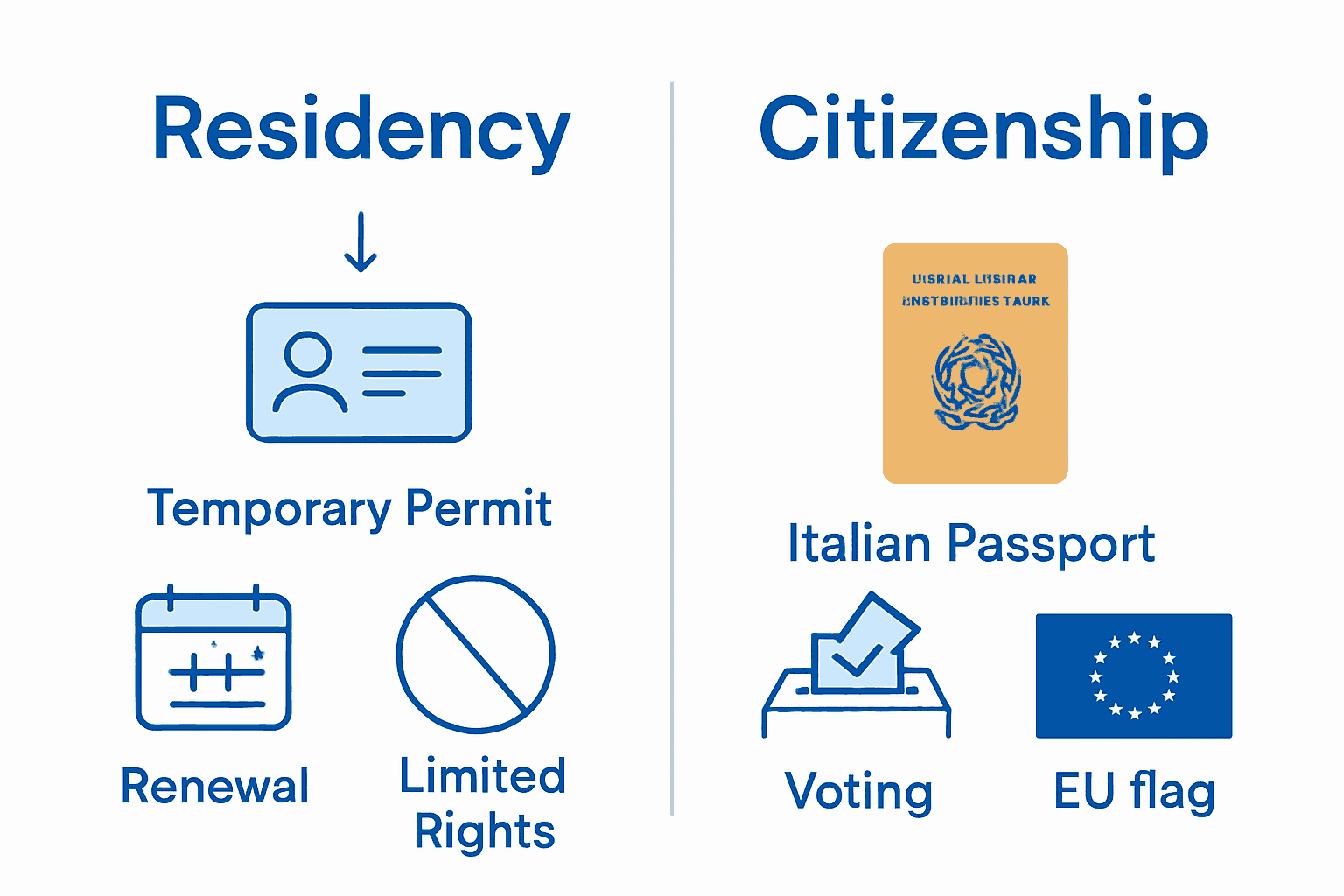
Residency Status
- Temporary right to live in Italy
- Limited political participation
- Requires periodic renewal
- Subject to specific visa/permit regulations
-
Citizenship Status
- Permanent legal membership in Italian state
- Full political rights (voting, running for office)
- Passport eligibility
- Unrestricted work and travel permissions
Understanding these differences is crucial for expatriates, investors, and professionals planning long-term engagement with Italy. For a deeper exploration of citizenship pathways, check out our guide on Italian Citizenship by Ancestry.
Residency in Italy: Types, Process, and Limits
Navigating the Italian residency landscape requires a nuanced understanding of various legal frameworks designed to accommodate different types of foreign residents. The process involves multiple categories of residency permits, each tailored to specific circumstances such as work, study, family reunification, or investment.
A critical first step in establishing legal residency involves obtaining the Codice Fiscale, which serves as a fundamental identifier. As Wikipedia explains, this unique fiscal code is essential for numerous activities in Italy, including opening bank accounts, signing leases, and engaging in financial transactions. Without this document, foreign nationals will find it challenging to integrate into Italian administrative and economic systems.

Residency permits in Italy are typically categorized into several key types:
-
Temporary Residence Permit (Permesso di Soggiorno)
- Valid for specific purposes (work, study, family)
- Requires periodic renewal
- Limited duration (usually 1-2 years)
-
Long-Term Residence Permit (Carta di Soggiorno)
- Granted after 5 continuous years of legal residence
- Provides more stability and fewer renewal requirements
- Offers expanded rights similar to permanent residency
-
Work-Related Residence Permits
- Specific to employment contracts
- Tied to specific job or professional category
- Requires sponsorship from Italian employer
For digital professionals seeking alternative pathways, exploring the Digital Nomad Visa can provide additional insights into modern residency options. Understanding these nuanced categories is crucial for anyone planning to establish a legal presence in Italy, as each permit type carries distinct rights, obligations, and potential pathways to long-term residency or citizenship.
Understanding Italian Citizenship: Eligibility and Routes
Navigating the intricate landscape of Italian citizenship requires a comprehensive understanding of the multiple pathways available to foreign nationals seeking legal membership in the Italian state. The journey to becoming an Italian citizen is complex, involving several distinct routes that cater to different individual circumstances and backgrounds.
According to Wikipedia, Italian nationality law provides multiple mechanisms for acquiring citizenship, including descent (jus sanguinis), birth (jus soli), marriage, and naturalization. Each pathway carries unique requirements, documentation, and legal implications that prospective applicants must carefully navigate.
The naturalization process represents one of the most structured routes to Italian citizenship. As Wikipedia highlights, the standard naturalization process requires ten years of continuous legal residence. However, this timeline can be significantly reduced under specific circumstances:
-
Standard Naturalization
- 10 years of continuous legal residence
- Demonstrates substantial integration into Italian society
- Requires comprehensive documentation
-
Expedited Naturalization Routes
- 5 years for stateless individuals or refugees
- 4 years for European Union citizens
- Specialized provisions for specific professional or humanitarian contexts
Key citizenship acquisition routes include:
-
Citizenship by Descent (Jus Sanguinis)
- Inherited through Italian parentage
- No generational limit in some cases
- Requires documented Italian ancestry
-
Citizenship by Marriage
- Available to foreign spouses of Italian citizens
- Requires specific residency and language proficiency conditions
-
Citizenship by Naturalization
- Longest and most complex route
- Demonstrates long-term commitment to Italy
Understanding how Jus Sanguinis works in Italy can provide deeper insights into one of the most accessible pathways to Italian citizenship, especially for individuals with Italian ancestral connections.
Key Rights and Legal Differences Explained
The distinction between residency and citizenship in Italy carries profound implications for personal and professional rights, creating a complex legal landscape that significantly impacts an individual’s opportunities and freedoms within the country and across Europe.
As Wikipedia reveals, the fundamental rights differ dramatically between residents and citizens. While both can obtain an identity card, only Italian citizens possess the privilege of using this document as a travel document throughout the European Economic Area and Switzerland. Moreover, citizens retain exclusive rights to vote and hold public office – critical political freedoms not extended to non-citizen residents.
The broader European context further illuminates these distinctions. According to Wikipedia, Italian citizenship automatically confers European Union citizenship, which unlocks an expansive set of transnational rights:
-
Political Rights
- Voting in European Parliament elections
- Running for political office in EU countries
- Participating in democratic processes across the EU
-
Economic Freedoms
- Unrestricted right to work in any EU member state
- Freedom of movement within the European Union
- Equal employment and professional opportunities
-
Social Protections
- Access to healthcare across EU countries
- Educational opportunities in multiple member states
- Social security portability
Key Comparative Rights:
-
Resident Rights
- Limited political participation
- Restricted employment options
- Temporary legal status
-
Citizen Rights
- Full political engagement
- Unrestricted professional opportunities
- Permanent legal status
For those interested in understanding the nuanced legal frameworks underlying these distinctions, our guide comparing Civil and Common Law systems provides deeper insights into the legal philosophical foundations that shape these rights.
Practical Implications for Foreigners in Italy
Foreign nationals navigating the Italian legal landscape face a complex array of bureaucratic challenges that demand strategic planning and meticulous documentation. Understanding the practical nuances between residency and citizenship becomes crucial for successfully integrating into Italian society and accessing essential services.
As Wikipedia emphasizes, obtaining the Codice Fiscale represents the foundational step for foreigners in Italy. This unique fiscal identifier is not merely a bureaucratic requirement but a critical gateway to fundamental activities such as opening bank accounts, signing lease agreements, accessing healthcare services, and establishing professional connections.
Practical considerations for foreigners can be categorized into several key domains:
-
Administrative Requirements
- Mandatory registration with local municipalities
- Periodic visa/permit renewals
- Documentation translation and authentication
-
Financial Implications
- Tax reporting obligations
- Banking and financial service access
- Investment and property ownership restrictions
-
Professional Opportunities
- Work permit limitations
- Professional credential recognition
- Sector-specific employment regulations
Key Strategic Considerations:
-
Residency-Level Engagement
- Limited social security benefits
- Restricted employment markets
- Temporary legal status
-
Citizenship-Level Integration
- Comprehensive social protection
- Unrestricted professional opportunities
- Permanent legal stability
For expatriates seeking deeper insights into navigating Italy’s complex healthcare system, our comprehensive healthcare guide for expats offers essential strategies for medical access and insurance navigation.
Make Your Move From Residency to Citizenship With Expert Legal Support
Understanding the complex differences between Italian residency and citizenship is vital but often overwhelming. If you are navigating issues like securing the right residency permit, meeting naturalization requirements, or grasping your legal rights as a foreigner, the challenge can feel daunting. You may worry about the lengthy paperwork, strict timelines, or subtle legal distinctions such as the Codice Fiscale, naturalization periods, and political rights tied to citizenship.
At Expats in Italy – Legal Guide and Resources, Avv. Alfredo Esposito offers clear, personalized guidance to help you overcome these hurdles efficiently. With a deep understanding of Italy’s legal system and a commitment to bridging language and cultural gaps, we provide you with transparent advice and trustworthy support every step of the way. Whether you are seeking residency permits or exploring pathways to permanent citizenship, do not wait for uncertainty to hold you back. Visit https://alfredoesposito.eu now and take your first step toward securing your Italian legal status with confidence. Learn more legal tips at Legal Tips in Italy • Avv. Alfredo Esposito and empower your decisions today.
Frequently Asked Questions
What is the difference between residency and citizenship in Italy?
Residency allows a foreign national to live in Italy temporarily, whereas citizenship provides permanent legal membership with full rights and privileges within the Italian state, including voting and passport eligibility.
How can one obtain Italian citizenship through descent?
Italian citizenship by descent, or jus sanguinis, allows individuals to claim citizenship if they can document Italian ancestry. There is typically no generational limit, allowing for citizenship claims by descendants of Italian citizens.
What types of residency permits are available in Italy?
Italy offers various residency permits including Temporary Residence Permits (valid for specific purposes such as work or study), Long-Term Residence Permits (granted after five years of legal residence), and Work-Related Residence Permits, each with specific rights and renewal requirements.
What are the main rights of Italian citizens compared to legal residents?
Italian citizens enjoy full political rights, including the right to vote and run for office, as well as unrestricted work and travel permissions across the EU. In contrast, legal residents have limited political participation and must adhere to specific work and residency conditions.