Moving to Italy as an american brings a wave of new rules, especially for those planning to drive. Over 60 percent of international residents say licence exchanges are among their top legal challenges. Understanding how driving licence exchange agreements work can save you from expensive mistakes and legal setbacks. This guide offers clear answers so you can legally drive in Italy without confusion or unexpected delays.
Table of Contents
- Driving Licence Exchange Agreements Explained
- Countries with Full Reciprocity Agreements
- Partial Reciprocity: Special Categories and Limits
- Exchange Procedures and Required Documents
- Deadlines, Rules, and Critical Considerations
Key Takeaways
| Point | Details |
|---|---|
| Driving Licence Exchange | Foreign nationals can transition their existing driving licences to Italian documentation without extensive bureaucracy, subject to specific conditions based on residency status and licence validity. |
| Reciprocity Agreements | Italy has established full reciprocity agreements with several countries, allowing licence exchanges without additional tests, benefiting residents from those nations. |
| Partial Reciprocity Challenges | Certain groups, like diplomats and researchers, face distinct regulations and documentation requirements when exchanging driving licences under partial reciprocity agreements. |
| Critical Deadlines | EU citizens enjoy a two-year window to convert licences, while non-EU citizens must exchange within 12 months to maintain legal driving privileges in Italy. |
Driving Licence Exchange Agreements Explained
Understanding driving licence exchange agreements is critical for expatriates and international residents navigating Italy’s complex transportation regulations. Driving licence exchanges represent a crucial legal mechanism that allows foreign nationals to transition their existing driving credentials into Italian documentation without unnecessary bureaucratic hurdles.
According to Europa, the European Union provides a comprehensive framework for mutual recognition and exchange of driving licences among member states. This framework enables residents to exchange their existing licences under specific conditions, typically without requiring additional driving tests. The key considerations for licence exchanges include:
- Validity of the original driving licence
- Residency status in Italy
- Type and classification of the existing driving credential
- Duration of previous licence ownership
For European Union and European Economic Area citizens, the process is relatively straightforward. These individuals can legally drive using their original licence until its expiration date, after which they can convert it to an Italian licence through a simplified exchange procedure. Non-European nationals face slightly more complex requirements, typically needing to complete the exchange within 12 months of establishing official residency.
Important nuances exist within these regulations. For instance, if your EU licence does not display an explicit expiration date, you will have a two-year window from your official resident registration date to complete the exchange. Non-EU nationals must additionally provide an International Driving Permit or a certified Italian translation of their original licence during the 12-month transition period.
Navigating these regulations demands careful attention to documentation, timing, and specific administrative requirements.
 Consulting with local transportation authorities or a legal professional specializing in expatriate documentation can help ensure a smooth and compliant licence exchange process.
Countries with Full Reciprocity Agreements
Driving licence reciprocity represents a critical legal framework enabling smooth transportation transitions for international residents and expatriates. Bilateral agreements between countries establish clear pathways for mutually recognizing driving credentials, simplifying administrative processes for individuals relocating across international borders.
According to Gov UK, the United Kingdom and Italy have established a comprehensive agreement allowing residents to exchange their driving licences without additional testing requirements. This reciprocity demonstrates a progressive approach to international mobility and legal documentation recognition.
Several key countries have developed full reciprocity agreements with Italy, including:
- European Union member states
- United Kingdom
- Switzerland
- Morocco
- Canada
- Australia
- New Zealand
- Some South American nations
Morocco World News further highlights the evolving landscape of international licence exchanges, noting that Morocco and Italy have specifically established a mutual recognition agreement. Such agreements typically eliminate the need for residents to undergo further driving examinations when transferring their licences.
The specific requirements for licence exchanges vary depending on the originating country’s agreement with Italy. Generally, individuals must provide original documentation, proof of residency, and meet specific medical and administrative criteria. Some countries require additional steps like certified translations or medical evaluations, while others offer more streamlined processes.
Navigating these reciprocity agreements demands careful research and potential consultation with legal professionals specializing in international documentation. Understanding the nuanced requirements can help expatriates and international residents smoothly transition their driving credentials and maintain legal compliance across different jurisdictions.
Partial Reciprocity: Special Categories and Limits
Driving licence exchanges are not always straightforward, with partial reciprocity creating unique challenges for certain international residents. These nuanced agreements recognize that not all driving credentials can be seamlessly transferred across borders, requiring specialized considerations for different professional and personal circumstances.
According to Esteri, Italy maintains partial reciprocity agreements that specifically accommodate special categories of individuals, such as diplomatic personnel. These targeted arrangements allow specific groups to exchange their driving licences with reduced bureaucratic barriers, acknowledging the unique mobility requirements of certain professional contexts.
Special categories typically eligible for partial reciprocity include:
- Diplomatic staff and their immediate family members
- International organization employees
- Military personnel on international assignments
- Researchers and academic professionals
- Expatriate workers with specific employment contracts
- Students participating in long-term international exchange programs
The limitations of partial reciprocity agreements often involve strict documentation requirements and time-sensitive conditions. Individuals must typically provide:
- Original driving licence with certified translations
- Proof of current residency status
- Valid passport or identification documents
- Medical fitness certificates
- Verification of professional status or purpose of stay
These partial agreements recognize that while full reciprocity might not be possible, targeted provisions can facilitate smoother administrative processes for specific international residents.
The complexity of these arrangements underscores the importance of consulting official sources and potentially seeking legal guidance to navigate the intricate landscape of international driving licence exchanges.
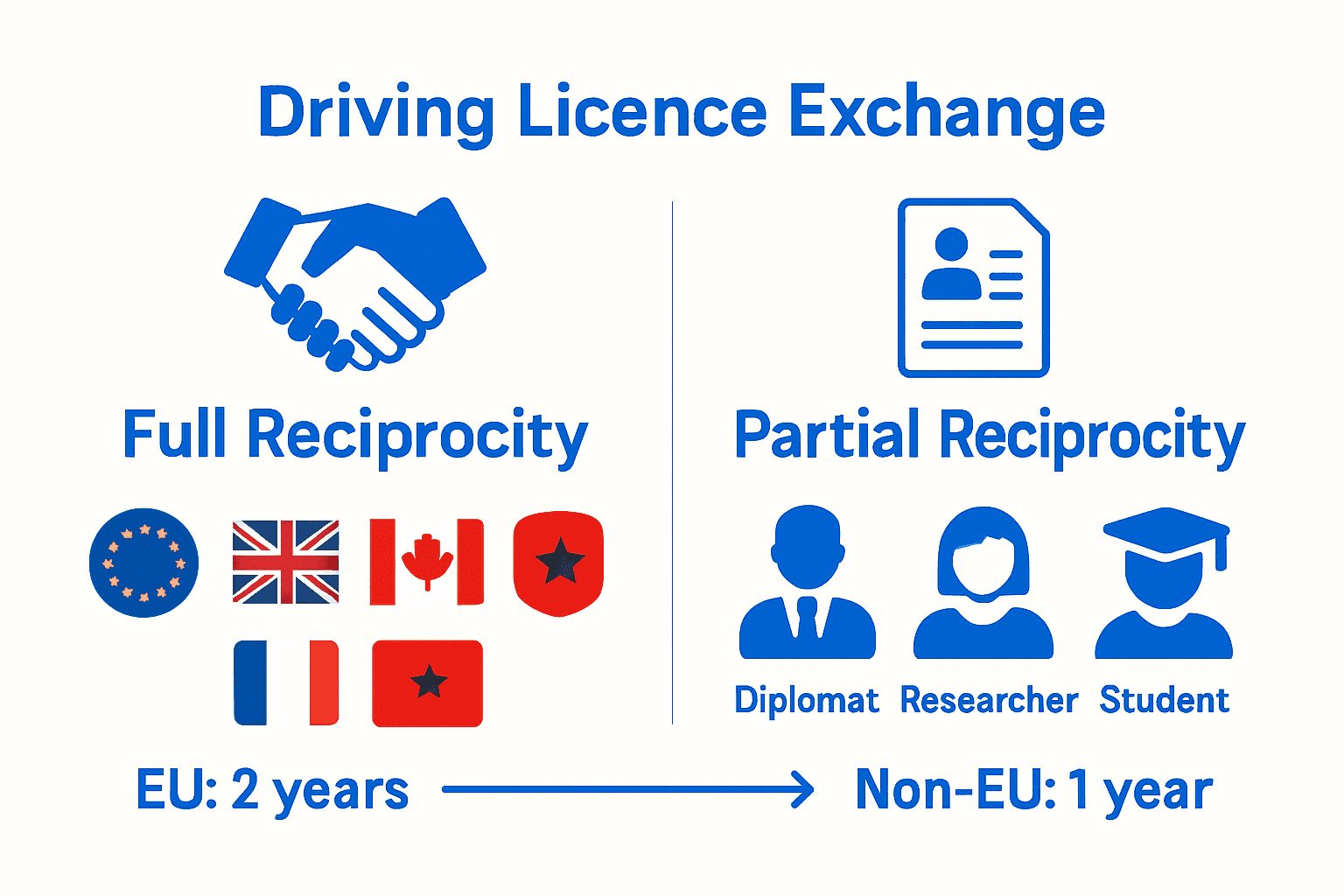
Navigating partial reciprocity demands meticulous attention to detail and proactive documentation preparation. Each case is unique, and the specific requirements can vary significantly depending on an individual’s professional status, country of origin, and intended duration of stay in Italy.
Exchange Procedures and Required Documents
Navigating the driving licence exchange process in Italy requires meticulous preparation and understanding of complex administrative requirements. Documentation preparation stands as a critical first step for expatriates and international residents seeking to legally operate a vehicle within Italian borders.
ACI provides comprehensive guidance on the intricate procedures for exchanging foreign driving licences, highlighting the distinct processes for EU and non-EU citizens.
Standard documentation requirements typically include:
- Original driving licence
- Certified Italian translation of the original licence
- Valid passport or residence permit
- Passport-sized photographs
- Proof of residency
- Medical certificate demonstrating fitness to drive
- Payment of administrative processing fees
ACI Cittadinanza Italiana emphasizes that non-EU citizens have a specific 12-month window to drive using their original licence before mandatory conversion becomes necessary. This timeframe requires careful tracking to maintain legal driving status.
The exchange procedure generally follows these sequential steps:
- Gather all required original documentation
- Obtain certified Italian translations
- Complete a medical examination
- Submit application to local motorizzazione civile (motor vehicle department)
- Pay required administrative fees
- Undergo potential vision and theoretical driving tests
Important nuances exist between EU and non-EU licence exchanges. EU citizens typically experience a more streamlined process with minimal additional testing, while non-EU nationals might face more rigorous verification procedures. Potential applicants should anticipate varying processing times and be prepared to provide supplementary documentation if requested.
Ultimately, successfully navigating the driving licence exchange requires patience, thorough document preparation, and proactive engagement with Italian transportation authorities. Consulting with local experts or legal professionals specializing in expatriate documentation can significantly simplify this complex administrative journey.
Deadlines, Rules, and Critical Considerations
Driving licence exchanges involve intricate legal timelines that can significantly impact an expatriate’s ability to legally operate a vehicle in Italy. Understanding these nuanced regulations is crucial for maintaining continuous driving privileges and avoiding potential legal complications.
Esteri highlights the complex landscape of international driving regulations, emphasizing that different countries impose unique requirements for licence recognition and conversion.
Critical deadlines vary significantly based on residency status:
- EU Citizens: Two-year window from residency registration
- Non-EU Citizens: Strict 12-month driving period with original licence
- Diplomatic Personnel: Special expedited conversion processes
- Students: Unique time-limited conversion allowances
Europa provides additional insights into the intricate EU regulations surrounding driving licence exchanges, noting that medical assessments and validity checks are integral components of the conversion process.
Key considerations that can impact licence exchange include:
- Current licence expiration date
- Total duration of previous licence ownership
- Medical fitness certification
- Criminal driving record
- Specific vehicle category restrictions
- Professional driving status
Penalties for non-compliance can be substantial. Driving with an invalid or improperly converted licence may result in:
- Immediate vehicle impoundment
- Significant monetary fines
- Potential legal prosecution
- Suspension of driving privileges
The complexity of these regulations underscores the importance of proactive documentation management and timely licence conversion. Expatriates must remain vigilant about tracking their specific deadlines and maintaining comprehensive documentation throughout the exchange process.
Simplify Your Driving Licence Exchange Journey in Italy
Navigating the complexities of driving licence exchange agreements with Italy can be overwhelming. The challenges of meeting deadlines, providing the right documentation, and understanding partial or full reciprocity agreements create uncertainty and stress. If you are an expatriate or international resident, ensuring your licence complies with Italian laws is critical to maintain your driving privileges without risking fines or penalties. Key terms like “residency status,” “medical fitness certificates,” and “administrative processing fees” often create confusion that could delay your legal driving ability.
Don’t let paperwork or legal nuances slow you down. At Expats in Italy – Legal Guide and Resources, we specialize in assisting foreigners with these exact challenges. Our team led by Avv. Alfredo Esposito offers personalized guidance tailored to your unique situation including your country of origin and residence status. Act now to avoid last-minute complications and secure your driving rights smoothly. Visit Legal Tips in Italy for clear insights or start your process on our main site https://alfredoesposito.eu. Get expert help today and drive with confidence tomorrow.
Frequently Asked Questions
How can I exchange my driving licence in Italy?
To exchange your driving licence in Italy, you need to gather all necessary documentation, including your original licence, a certified Italian translation, your passport or residence permit, passport-sized photos, proof of residency, and a medical certificate. Then, submit your application to the local motorizzazione civile (motor vehicle department).
What is the time limit for exchanging a driving licence if I am a non-EU citizen?
Non-EU citizens have a strict 12-month window to exchange their driving licence upon establishing residency in Italy. During this time, they can still drive using their original licence.
Do EU citizens have a different process for exchanging their driving licences in Italy?
Yes, EU citizens typically follow a more streamlined process for exchanging their driving licences in Italy. They can legally drive using their original licence until its expiration date and can complete the exchange without additional driving tests.
What documents do I need to provide for the driving licence exchange process?
Key documents required include the original driving licence, a certified Italian translation of the original, a valid passport or residency permit, passport-sized photographs, proof of residency, a medical certificate, and payment of administrative fees.