Most International clients are surprised to learn that nearly 90 percent of civil disputes in Italy never reach a courtroom. Understanding dispute resolution matters because myths around negotiations and mediation can lead to costly mistakes. Whether you are an expatriate or an international business owner, knowing how these structured alternatives work can help you sidestep legal headaches and preserve relationships while saving precious time and money.

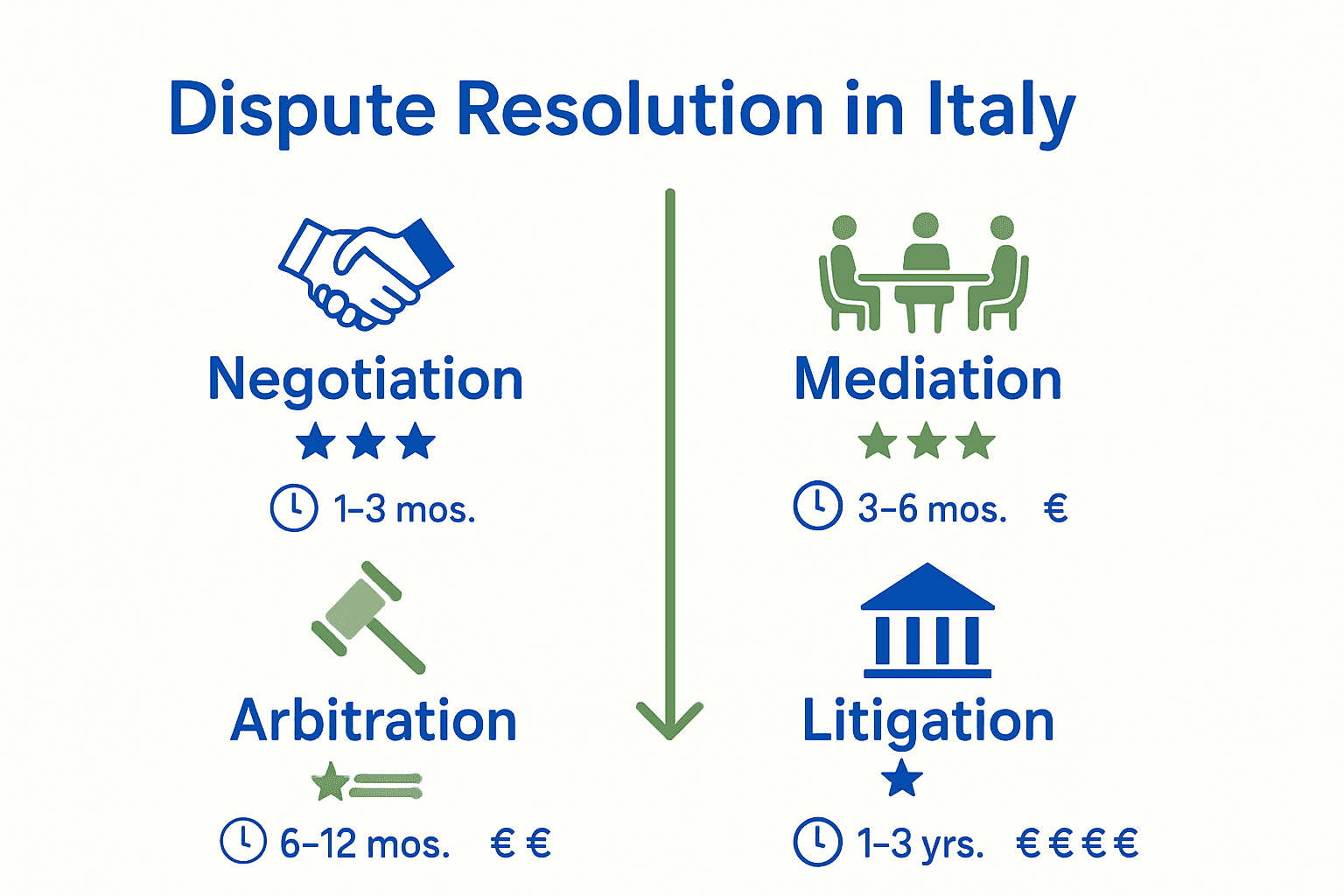

Quick Answer: Italy offers four main dispute resolution methods: (1) Negotiation (direct party communication), (2) Mediation (neutral facilitator, mandatory for certain disputes under D.Lgs. 28/2010), (3) Arbitration (binding third-party decision), and (4) Conciliation. ADR methods resolve disputes in 1-12 months vs. 3-7 years for litigation, at 50-70% lower cost. Mediation is mandatory before court for real estate, inheritance, medical malpractice, and banking disputes.
Key Numbers at a Glance:
Last updated: December 2025
- 90% — civil disputes in Italy resolved outside court
- 50-70% — cost savings with mediation vs. litigation
- 1-3 months — typical mediation timeline
- 3-7 years — average Italian civil litigation duration
- €500-3,000 — typical mediation costs
- €5,000-50,000+ — litigation costs range
Table of Contents
- Defining Dispute Resolution And Common Misconceptions
- Types Of Dispute Resolution In Italy
- Alternative To Court: ADR And Mediation
- Legal Framework And Consumer Rights Protections
- Costs, Risks, And Choosing The Right Method
- How Our Law Firm Supports International Clients
- Frequently Asked Questions
Key Takeaways
| Point | Details |
|---|---|
| Understanding ADR | Alternative Dispute Resolution methods (negotiation, mediation, arbitration) offer more efficient, cost-effective ways to resolve conflicts—typically 50-70% cheaper and 3-5 years faster than court. |
| Mandatory Mediation | Under D.Lgs. 28/2010, mediation is required before litigation for real estate, inheritance, medical malpractice, lease, and banking disputes. |
| Consumer Protections | Italy’s Consumer Protection Code provides robust safeguards including free ADR options, ODR platform for e-commerce, and access to consumer agencies (AGCM, ECC-Net). |
| Strategic Selection | Choosing the right method requires evaluating cost, timeline, relationship dynamics, enforceability needs, and confidentiality requirements. |
Defining Dispute Resolution and Common Misconceptions
Dispute resolution represents a comprehensive approach to addressing conflicts between parties without necessarily resorting to traditional court litigation. In the Italian legal landscape, this process involves multiple strategies designed to help individuals and businesses efficiently resolve disagreements while minimizing time, expense, and emotional strain. Alternative Dispute Resolution (ADR) encompasses several methods that provide structured pathways for conflict management. These approaches include negotiation, mediation, arbitration, and conciliation—each offering unique advantages depending on the specific circumstances of the dispute. The primary goal remains consistent: finding mutually acceptable solutions that preserve relationships and provide pragmatic resolutions.Common Misconceptions About Dispute Resolution
Many expatriates and international professionals harbor misconceptions about dispute resolution in Italy. Let’s debunk some of the most prevalent myths:- Myth 1: Litigation is Always the Best Solution Reality: Italian courts average 3-7 years for civil cases. ADR methods can resolve conflicts in months, at 50-70% lower cost.
- Myth 2: All Dispute Resolution Methods Are Identical Reality: Each method—mediation, arbitration, negotiation—has distinct procedures, costs, and outcomes. Mediation is collaborative; arbitration produces binding decisions.
- Myth 3: Dispute Resolution Is Only for Large Conflicts Reality: ADR works effectively for disputes ranging from €1,000 consumer complaints to multi-million euro commercial conflicts.
- Myth 4: ADR Outcomes Aren’t Legally Enforceable Reality: Mediation agreements can be certified (omologazione) by courts, making them fully enforceable. Arbitration awards have the same force as court judgments.
Types of Dispute Resolution in Italy
The Italian legal system offers multiple sophisticated dispute resolution mechanisms that provide alternatives to traditional court litigation. These methods are designed to offer flexible, efficient, and often more cost-effective approaches for resolving conflicts across various domains, including commercial, civil, and interpersonal disputes.Primary Dispute Resolution Methods
Italy recognizes several key dispute resolution types, each with unique characteristics and procedural frameworks:1. Negotiation
- Direct communication between parties without third-party involvement
- Lowest cost and most informal method
- Parties control the process and potential outcomes
- No legal formalities required
- Timeline: Days to weeks
2. Mediation (Mediazione)
- Neutral third-party facilitates communication
- Voluntary and confidential process
- Mandatory for certain disputes under D.Lgs. 28/2010
- Focuses on collaborative problem-solving
- Cost: €500-3,000 typically
- Timeline: 1-3 months
3. Arbitration (Arbitrato)
- More formal than mediation
- Binding decision made by neutral arbitrator(s)
- Governed by Articles 806-840 of the Italian Code of Civil Procedure
- Often used in commercial and international disputes
- Cost: €2,000-20,000+ depending on complexity
- Timeline: 6-12 months
4. Conciliation (Conciliazione)
- Similar to mediation but with more active involvement from the conciliator
- Government-supported process in certain legal contexts
- Common in labor disputes and consumer matters
- Aims to find mutually acceptable solutions
Comparison of Dispute Resolution Methods
| Method | Cost | Timeline | Binding? | Best For |
|---|---|---|---|---|
| Negotiation | Minimal | Days-Weeks | If agreed | Simple disputes, ongoing relationships |
| Mediation | €500-3,000 | 1-3 months | If certified | Real estate, inheritance, commercial |
| Arbitration | €2,000-20,000+ | 6-12 months | Yes | Complex commercial, international |
| Litigation | €5,000-50,000+ | 3-7 years | Yes | When ADR fails, precedent needed |
Specialized Dispute Resolution Contexts
Certain sectors in Italy have developed specialized dispute resolution mechanisms. Consumer disputes can be resolved through dedicated consumer protection agencies (AGCM), while workplace conflicts utilize labor mediation services through the Direzione Territoriale del Lavoro. Choosing the appropriate dispute resolution method depends on multiple factors: the nature of the conflict, relationship between parties, financial considerations, and desired outcomes. How to choose the right lawyer can significantly impact navigating these complex decision-making processes.Alternative to Court: ADR and Mediation
Alternative Dispute Resolution (ADR) represents a transformative approach to conflict management in the Italian legal system, offering expatriates and businesses strategic alternatives to traditional courtroom litigation. These methods provide more flexible, efficient, and often less expensive pathways to resolving complex disputes while preserving professional and personal relationships.Core Advantages of ADR and Mediation
The primary benefits of Alternative Dispute Resolution include:- Cost Efficiency: 50-70% lower expenses compared to court proceedings
- Time Savings: Disputes resolve in months rather than years
- Confidentiality: Private discussions remain outside public court records
- Relationship Preservation: Collaborative approaches minimize adversarial tensions
- Customized Solutions: Parties have more control over negotiation outcomes
- Enforceability: Certified agreements have full legal force
Mandatory Mediation in Italy
Under Legislative Decree 28/2010 (as amended by D.L. 69/2013), mediation is mandatory before court proceedings for specific dispute categories:- Real estate and property disputes (diritti reali)
- Inheritance and succession matters (successioni ereditarie)
- Family business divisions (divisione)
- Lease and rental agreements (locazione)
- Medical malpractice (responsabilità medica)
- Defamation (diffamazione)
- Insurance contracts (contratti assicurativi)
- Banking and financial disputes (contratti bancari e finanziari)
Important: Failure to attempt mandatory mediation before filing a lawsuit can result in case dismissal (improcedibilità). The mediation attempt must be conducted through an accredited mediation body (organismo di mediazione) registered with the Ministry of Justice.
Mediation: A Collaborative Approach
Mediation emerges as a particularly powerful ADR technique in Italy. This process involves a neutral third-party mediator who facilitates communication between conflicting parties, guiding them toward mutually acceptable resolutions. Unlike arbitration, mediators do not impose decisions but instead help participants discover common ground and craft innovative solutions. For international professionals navigating Italy’s complex legal landscape, understanding these alternatives becomes crucial. Rental Agreements & Tenancy Disputes Italy represents an excellent example of where ADR can provide swift, effective conflict resolution without extensive legal proceedings.
Legal Framework and Consumer Rights Protections
The Italian legal system provides robust consumer rights protections through a comprehensive framework designed to safeguard individuals against unfair practices and ensure transparent dispute resolution mechanisms. As ECC-Net Italia highlights, these protections extend beyond traditional litigation, offering consumers multiple avenues for addressing grievances and seeking justice.Key Consumer Protection Mechanisms
1. Consumer Protection Code (D.Lgs. 206/2005)
- Comprehensive legislation defining consumer rights
- Establishes clear standards for business conduct
- Provides mechanisms for addressing unfair commercial practices
- Implements EU Consumer Rights Directive
2. Alternative Dispute Resolution (ADR) Systems
- Streamlined processes for resolving consumer complaints
- Free or low-cost options through consumer associations
- Online Dispute Resolution (ODR) platform for e-commerce
- Faster and less formal than traditional court proceedings
3. Regulatory Bodies
- AGCM (Autorità Garante della Concorrenza e del Mercato): Competition and consumer protection authority
- IVASS: Insurance sector disputes
- Banca d’Italia/ABF: Banking and financial disputes
- AGCOM: Telecommunications disputes
Specific Protections for International Consumers
Expatriates and international consumers enjoy additional layers of protection under Italian and EU law:- Mandatory disclosure of contract terms in clear language
- 14-day withdrawal right for online purchases
- Protection against discriminatory practices
- Right to clear information (multilingual support available)
- Access to European Consumer Centre (ECC-Net) for cross-border disputes
Costs, Risks, and Choosing the Right Method
Dispute resolution strategies in Italy require careful consideration of multiple factors, balancing potential costs, time investments, and risks associated with different approaches. Expatriates and international professionals must strategically evaluate their specific situation to select the most appropriate conflict resolution method.Comparative Cost Analysis
| Method | Direct Costs | Time Investment | Key Considerations |
|---|---|---|---|
| Negotiation | Minimal (legal advice optional) | Days to weeks | Requires good faith from both parties |
| Mediation | €500-3,000 | 1-3 months | 50-70% cheaper than litigation; mandatory for certain disputes |
| Arbitration | €2,000-20,000+ | 6-12 months | Binding decision; limited appeal options |
| Litigation | €5,000-50,000+ | 3-7 years (first instance) | Highest cost; unpredictable duration; public record |
Risk Assessment Strategies
Effective dispute resolution requires comprehensive risk evaluation. Critical considerations include:- Relationship Impact: Will litigation damage ongoing business relationships?
- Confidentiality: Is privacy important? (Court proceedings are public)
- Enforceability: Do you need a binding, enforceable outcome?
- Precedent: Would a court ruling benefit future similar situations?
- Complexity: Does the dispute require expert technical evaluation?
- Urgency: How quickly do you need resolution?
How Our Law Firm Supports International Clients
International legal support requires more than just technical expertise—it demands cultural understanding, language proficiency, and a nuanced approach to navigating complex legal landscapes. Our law firm specializes in providing comprehensive dispute resolution services tailored specifically for expatriates, international professionals, and global businesses operating in Italy.Comprehensive Support Approach
1. Language and Cultural Translation
- Bilingual legal documentation (English/Italian)
- Cultural context interpretation
- Seamless communication bridging legal and linguistic gaps
2. Strategic Dispute Resolution
- Personalized conflict assessment
- Recommended resolution pathway selection
- Expert negotiation and mediation representation
- Arbitration advocacy when required
3. Comprehensive Legal Guidance
- Detailed explanation of Italian legal procedures
- Transparent cost and timeline expectations
- Ongoing consultation and strategic advice
Unique Client-Centered Services
We recognize that each international client faces unique challenges. Our approach involves:- Complimentary initial consultation
- Flexible communication channels (email, WhatsApp, video conferences)
- Nationwide legal representation capabilities
- Embassy-listed credentials (US, UK, Canada, Colombia)
Navigate Dispute Resolution in Italy with Expert Legal Support
Professional Dispute Resolution Services
Dealing with disputes in Italy can feel overwhelming, especially when navigating unfamiliar legal processes and language barriers. Whether you are facing mediation, arbitration, or seeking alternatives to court litigation, understanding and choosing the right dispute resolution method is critical to protect your interests and reduce stress. At Alfredo Esposito – International Law Firm, we specialize in bridging these gaps by offering clear, personalized legal assistance designed specifically for foreigners living or doing business in Italy. From helping you understand the nuances of negotiation and mediation to guiding you through complex arbitration or tenancy disputes, we provide expert support at every stage. Don’t let legal complexities hold you back. Contact us now to schedule your free initial consultation and take the first step toward an effective dispute resolution. Schedule Free ConsultationFrequently Asked Questions
What is dispute resolution, and why is it important for expats?
Dispute resolution encompasses various methods to address conflicts between parties without traditional court litigation, including negotiation, mediation, arbitration, and conciliation. It’s vital for expats because nearly 90% of civil disputes in Italy are resolved outside court, saving significant time (months vs. years) and costs (50-70% less than litigation) while preserving business and personal relationships.
What are the main types of alternative dispute resolution (ADR) methods available in Italy?
Italy offers four primary ADR methods: (1) Negotiation—direct communication between parties, lowest cost; (2) Mediation—neutral third-party facilitates discussion, typically 50-70% cheaper than litigation; (3) Arbitration—formal process with binding decision by arbitrator(s); (4) Conciliation—similar to mediation with more active conciliator involvement. Each method suits different dispute types and relationship dynamics.
How does mediation work in Italy?
Mediation in Italy involves a neutral third-party mediator who facilitates communication between conflicting parties to help them find mutually acceptable solutions. Under Legislative Decree 28/2010, mediation is mandatory before litigation for certain disputes (real estate, inheritance, medical malpractice, banking). The process is confidential, and typically resolves within 1-3 months. Mediators don’t impose decisions but guide parties toward consensus. Successful agreements can be certified by courts for full enforceability.
Is mediation mandatory in Italy?
Yes, for certain dispute categories. Under D.Lgs. 28/2010 (as amended), mediation is mandatory before court proceedings for: real estate disputes, inheritance matters, family business divisions, lease agreements, medical malpractice, defamation, insurance contracts, and banking/financial disputes. Failure to attempt mediation can result in case dismissal (improcedibilità).
What are the costs of different dispute resolution methods in Italy?
Costs vary significantly by method: Negotiation has minimal direct costs (mainly time investment). Mediation typically costs €500-3,000 total, 50-70% less than litigation. Arbitration ranges from €2,000-20,000+ depending on complexity. Litigation is most expensive with legal fees of €5,000-50,000+, court costs, and unpredictable duration (average 3-7 years for civil cases in Italy).
How long does dispute resolution take compared to Italian courts?
ADR methods are significantly faster: Negotiation can resolve disputes in days to weeks. Mediation typically takes 1-3 months. Arbitration usually completes within 6-12 months. In contrast, Italian civil litigation averages 3-7 years for first instance, with appeals potentially adding 2-4 more years. This time difference makes ADR particularly attractive for business disputes requiring quick resolution.
What consumer protections exist for dispute resolution in Italy?
Italy’s Consumer Protection Code (D.Lgs. 206/2005) provides robust protections including: mandatory ADR procedures for consumer disputes, free or low-cost resolution options through consumer associations, Online Dispute Resolution (ODR) platform for e-commerce disputes, and access to consumer protection agencies (AGCM). The European Consumer Centre (ECC-Net Italia) assists with cross-border disputes within the EU.
Can arbitration decisions be appealed in Italy?
Arbitration decisions (lodi arbitrali) in Italy are generally binding and have limited appeal grounds. Under the Italian Code of Civil Procedure (Articles 827-831), appeals are only possible for: procedural violations, lack of arbitrator jurisdiction, violation of due process, or conflict with public policy (ordine pubblico). This finality is both an advantage (quick, definitive resolution) and a consideration (limited recourse) when choosing arbitration.
Recommended
- 7 Key Advantages of Hiring an Italian Lawyer Abroad
- Rental Agreements & Tenancy Disputes Italy
- How to Choose the Right Lawyer in Italy
- Complete Guide to Crimes in Italy for Expats
- How to File a Criminal Complaint in Italy